
Akademie der Naturwissenschaften Schweiz SCNAT
Handbook on natural history collections management – A collaborative Swiss perspective
Swiss natural history museums, botanical gardens, universities and other institutions for higher education collectively maintain collections with over 60 million specimens of animals, fungi, plants, rocks and fossils. To speed up, harmonise and better coordinate their digitisation, the SwissCollNet initiative was established by the Swiss Academy of Sciences and the Swiss collection-holding institutions.
This handbook is one of SwissCollNet’s first achievment to advance the exchange of knowledge on object and data management among Swiss collections. It contains instructions to modernise natural history collections of preserved biological materials and geological samples developed by experts and collections managers from across Swiss collection-holding institutions.
Frick H, Greeff M (2021) Handbook on natural history collections management – A collaborative Swiss perspective. Swiss Academies Communications 16 (2).

Schweizerische Akademie der Geistes- und Sozialwissenschaften
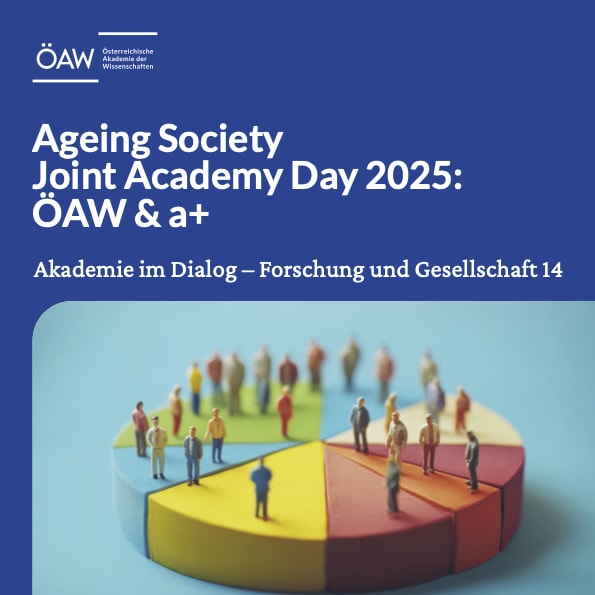
Ageing Society: Perspektiven auf eine alternde Gesellschaft
Wie können Gesellschaften Alter(n) differenzierter denken?
Die Publikation zum Joint Academy Day 2025 der Österreichischen Akademie der Wissenschaften (ÖAW) versammelt interdisziplinäre Perspektiven auf die gesellschaftlichen, wirtschaftlichen, kulturellen und ethischen Dimensionen des Alterns.
Die Beiträge laden dazu ein, Alter(n) nicht nur als Herausforderung, sondern in seiner Vielfalt und als gesamtgesellschaftliche Aufgabe zu betrachten.
Junge Akademie Schweiz JAS

Compassionate Science - Integrating Empathy and Compassion in Research
This report explores how empathy and compassion shape research practices across disciplines. Drawing on a review of existing literature and illustrative examples from early-career researchers, it shows that empathy and compassion are not abstract ideals but practical dimensions of research that can influence study design, relationships, data interpretation, and knowledge translation. Across fields, integrating these dimensions can strengthen trust, deepen understanding, improve collaboration, and enhance ethical reflexivity.
Akademie der Naturwissenschaften Schweiz SCNAT

Baukosten und Finanzierung von neuen Kernkraftwerken in der Schweiz
Der vorliegende Bericht bietet eine detailliertere Analyse über die beobachtete Entwicklung der Baukosten von neuen KKW und erörtert die möglichen Kosten eines allfälligen Neubaus in der Schweiz sowie deren Unsicherheiten. Zudem werden aktuelle Finanzierungsmodelle in Europa sowie die mit einem Bau verbundenen finanziellen Risiken für den Staat und die Wirtschaft dargestellt.